
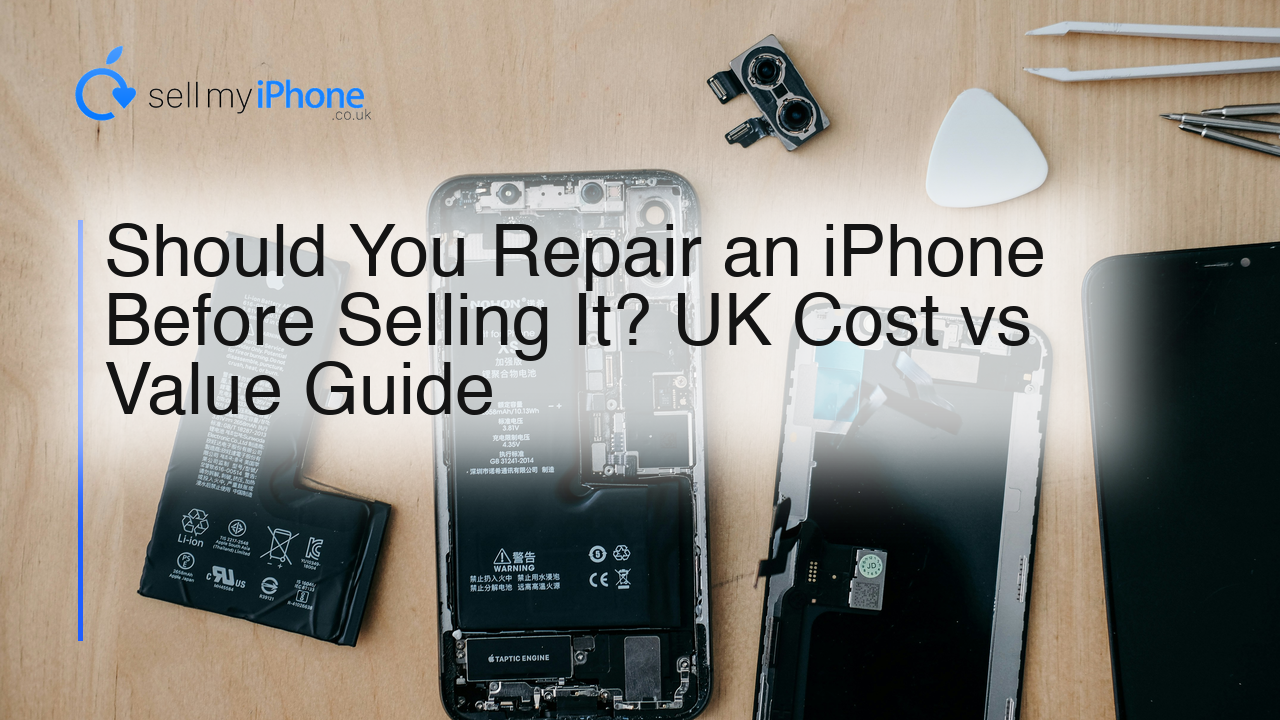
Repairing an iPhone before selling can increase value – but only sometimes. Too many sellers treat every fault as something that should be fixed first. In reality, some repairs improve the net result, some barely change it, and some simply pour money into a phone a buyer would have taken as-is.
Practical guidance: this guide focuses on the checks and decisions that most often affect value, payout speed and sale certainty for UK iPhone sellers.
Ask the commercial question first
The right question is not “Can this be repaired?” It is “Will this repair increase my net return after parts, labour, delay and extra risk?”
That means looking at three numbers together:
- the likely sale price as-is;
- the likely sale price after repair;
- the real cost and inconvenience of getting the work done.
If the uplift is marginal, the repair probably is not worth it.
Which repairs can make sense
On the right premium Apple model, a straightforward screen repair can sometimes be commercially justified, especially if the device is otherwise clean and you are trying to keep it in a stronger resale bracket.
By contrast, cheap high-street fixes do not automatically create value. If the result is poor, or the part lowers buyer confidence, the “repair” can be neutral at best and harmful at worst.
A repair only makes sense if it improves the final outcome more than it increases cost, delay and risk.
Which repairs usually do not pay back
Battery, charging and multi-fault repairs on older or more worn devices often fail the maths. You are adding cost to stock that may still be valued primarily as used, not premium. Likewise, once a phone has stacked faults, the uncertainty can remain even after one visible issue is fixed.
If the device is already likely to be re-graded downward, selling honestly as-is can be the cleaner choice.
A practical repair decision rule
- Get a realistic as-is quote.
- Estimate the repaired value conservatively, not optimistically.
- Only proceed if the uplift clearly exceeds the repair cost and the delay is acceptable.
- If you still have doubts, sell as-is and let the trade buyer price the risk.
The point is not to avoid all repairs. It is to avoid emotional repairs that feel tidy but do not improve your outcome.
When a repair makes sense and when it does not
A repair only makes sense if it improves the net outcome after cost, delay, and risk. That means asking one simple question: will the repair move the handset into a meaningfully better resale route, or are you just spending money to make it look easier to sell? Cosmetic fixes that do not materially improve grade or buyer confidence can be wasted spend.
Battery replacements and premium-screen repairs are the most common cases people consider, but even then the answer is not automatic. If the device is already older, heavily worn, or has multiple faults, the repair cost can stack on top of a phone that still ends up in a lower-value route. In those cases, selling honestly as-is is often the better commercial decision.
- Calculate the likely uplift before paying for any repair.
- Do not repair a phone just because the damage annoys you.
- If the handset has multiple faults, be extra cautious about throwing more money at it.
Quick answers
Should I always repair a cracked screen before selling?
No. It can make sense on some premium devices, but not every repair improves the net result.
What is the biggest repair mistake?
Spending money on a fix without checking whether the uplift in sale value actually exceeds the cost.
When is selling as-is better?
Often when the phone is older, the faults are stacked, or the repair economics are marginal.