
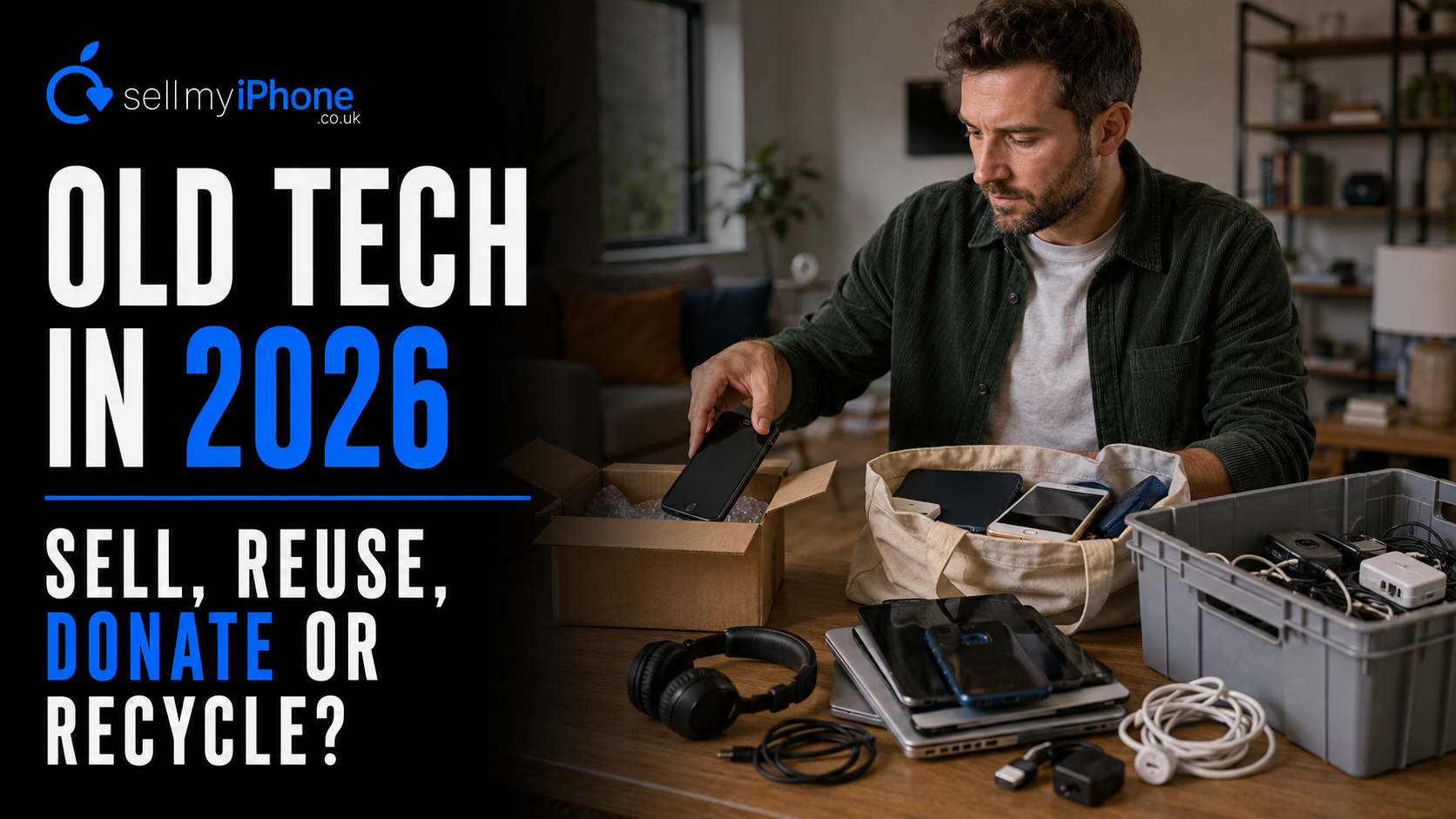
What to Do With Old Tech in 2026: Sell, Reuse, Donate or Recycle?
If you have an old phone, tablet, smartwatch, games console or pair of wireless earbuds sitting unused, do not automatically throw it away — and do not assume it has no value. Check whether the device can still be reused or sold first. If it genuinely has no useful life or commercial value left, recycle it through an appropriate electrical recycling route rather than putting it in your household bin.
That advice has become particularly relevant in 2026.
In June, the UK government's Department for Science, Innovation and Technology updated its IT Reuse for Good Charter, promoting a “reuse first” approach to technology.
The guidance highlights a remarkable figure: more than 200 million devices are sitting unused in British homes.
That is not simply an environmental statistic. Some of those forgotten devices still have practical or financial value.
The phone replaced two years ago, the tablet nobody uses, an old Apple Watch or Galaxy Watch, a games console from the previous generation or the earbuds left behind after an upgrade could all be worth checking before they disappear into a drawer for another five years.
Quick answer: If old technology still works or can realistically be repaired, look at reuse or resale before recycling it. If it has no useful or commercial life left, recycle it properly. The longer a saleable device sits unused, the more likely its resale value is to fall.
Why are so many old devices sitting unused in UK homes?
Technology accumulates surprisingly quickly.
A new phone arrives, but the previous one gets kept “just in case”. A tablet gets replaced by a newer model. Someone changes smartwatch ecosystem. A games console moves from beneath the television to a cupboard when the next generation arrives.
None of those devices necessarily feels like rubbish.
That is partly why they remain in homes.
An old smartphone can contain photographs and accounts. A previous tablet might still work perfectly. A console may feel too valuable to throw away even when nobody plays it.
So people postpone the decision.
One unused device becomes two, then three.
The government's current reuse guidance puts the scale of that behaviour into context. Its estimate of more than 200 million unused devices in British homes means the issue extends far beyond a few forgotten mobile phones.
Importantly, the government's new Charter is aimed primarily at organisations managing IT assets rather than telling individual households what to do with a particular phone. However, its central principle is useful for consumers too:
reuse something that still has useful life before treating it purely as waste.
What counts as old tech that may still have value?
Far more than phones.
Despite its name, Sell My iPhone's current device catalogue is not limited to iPhones or even to mobile phones.
The live catalogue includes several broad categories:
| Type of old tech | Examples |
|---|---|
| Phones | iPhone, Samsung Galaxy, Google Pixel, OnePlus, Nothing, Motorola, OPPO and many older mobile brands |
| Tablets | iPad, Samsung Galaxy Tab, Amazon, Google and other tablets |
| Smartwatches | Apple Watch, Samsung Galaxy Watch and Garmin devices |
| Games consoles | Selected Nintendo, Samsung, Sony and Microsoft-related devices listed within the current catalogue |
| Audio | Selected headphones and wireless audio devices |
The exact models and valuations change over time, so the useful approach is to search for the specific device rather than assuming it is too old or too unusual.
That distinction matters.
People often know that a recent flagship smartphone can be sold, yet assume an ageing tablet or previous smartwatch is effectively worthless.
Sometimes it is.
Sometimes it is not.
Should you sell, keep, donate or recycle old technology?
There is no single correct answer.
The best choice depends on whether you still need the device, whether somebody else can use it and whether it retains commercial value.
A simple decision looks like this:
| Situation | Usually worth considering |
|---|---|
| Device works and you no longer use it | Sell or donate |
| Device works and you genuinely need a backup | Keep |
| Device has repairable faults | Check resale value before deciding |
| Device has little monetary value but remains useful | Donate or reuse |
| Device cannot be sensibly reused or repaired | Recycle properly |
| Battery is badly damaged, swollen or unsafe | Stop using it and follow appropriate battery/electrical disposal advice |
The key mistake is skipping directly from “I don't use this anymore” to “this is rubbish”.
Those are different things.
When should you sell old tech?
Selling makes the most sense when a device is no longer useful to you but still has demand elsewhere.
This often happens immediately after an upgrade.
Perhaps you have moved from one Samsung Galaxy to another. Your previous phone still works, but you know you are never realistically going to switch back.
The same logic applies to tablets and watches.
Once your new device is set up and you are confident your data has transferred correctly, the old device has effectively become a depreciating asset sitting in your home.
Old technology generally does not improve with age
There are exceptions in collectible technology, but ordinary consumer electronics tend to move in the opposite direction.
New generations arrive.
Batteries age.
Software support changes.
Used supply increases as other owners upgrade.
Eventually, the device can cross the line where repair, testing and resale costs become too high relative to what somebody will pay for it.
Sell My iPhone's current FAQs make the same basic point: device values generally trend downwards over time.
That does not mean you need to rush into selling something you still use.
It means that keeping an unwanted device for another two years is rarely a strategy for increasing its value.
Is your old phone worth anything?
Possibly.
Age alone does not determine a mobile phone's value.
A relatively old flagship can sometimes retain more demand than a much newer budget handset. Storage, condition, battery performance and whether the phone works correctly all matter.
Brand matters too.
Used demand for an older Samsung Galaxy S model, Google Pixel or iPhone may differ significantly from demand for a less common handset of a similar age.
Consequently, the simplest way to answer “how much is my old phone worth?” is not to rely on its original price.
Search for the exact model.
Sell My iPhone currently lists a wide range of phone manufacturers, including Apple, Samsung, Google, Motorola, OnePlus, Nothing, OPPO and many others.
If your model does not appear, the site's FAQs say you can contact the company and it may still be able to make an offer.
Are old tablets worth selling?
Tablets are particularly easy to forget because they often remain usable long after somebody stops using them regularly.
An old iPad may have been replaced by a laptop. A Galaxy Tab might have become a kitchen-screen device before eventually moving into a drawer.
Yet tablets can retain value because another owner may have much simpler requirements.
A device that no longer feels fast enough for your work might still suit somebody who wants a tablet for streaming, reading, browsing or children's apps.
The important factors include the exact model, storage, connectivity and condition.
For example, Wi-Fi and cellular versions of the same tablet are not necessarily equivalent products.
If you have an old iPad, Galaxy Tab or another supported tablet, search the tablet section of the Sell My iPhone device catalogue before assuming its value is negligible.
What about old smartwatches?
Smartwatches create another common drawer problem.
People often upgrade their watch alongside a new phone, move between Apple and Android, or simply stop wearing one.
The result is a device that may remain perfectly functional but unused.
Condition can be particularly important here because smartwatches spend their lives exposed to knocks, scratches, sweat and repeated charging.
A watch with a heavily scratched display, tired battery or damaged casing will not be equivalent to the same model in cleaner condition.
Nevertheless, older wearable technology can still have a market.
Sell My iPhone's current catalogue includes smartwatches from brands including Apple, Samsung and Garmin.
Before selling an account-linked wearable, make sure you understand how to remove it correctly from the associated account or phone.
For Apple devices, our guide to unpairing an Apple Watch before selling covers the process.
Can you sell old games consoles too?
This is one of the less obvious parts of the Sell My iPhone catalogue.
The current Sell Your Device page includes a dedicated Games consoles category alongside phones, tablets, audio and smartwatches.
That makes the site relevant to households doing a wider technology clear-out rather than simply replacing a mobile.
A games console can remain useful for years after a newer generation appears. As with phones, however, condition and exact model matter.
Before valuing one, make sure you know precisely which version you own.
A base console, later revision and premium model can look similar while having different specifications and resale values.
You should also remove personal accounts and stored payment information before passing a console to somebody else.
Can damaged old tech still be worth money?
Yes. A fault does not automatically mean a device is worthless.
This is one of the most useful checks to make before recycling something.
Sell My iPhone's current FAQs state that it buys both working and damaged devices. It also says its UK repair centre has repaired more than 200,000 devices.
Whether a particular faulty device has value will depend on the problem.
A cracked screen is different from extensive liquid damage. A weak battery is different from a device that has suffered major board failure.
Even a device that cannot be resold intact may sometimes have value because repair or usable parts are possible.
However, not every fault makes economic sense to repair.
That is why you should check the as-is value before spending money fixing old technology purely to sell it.
What if the device is completely dead?
Do not immediately put it in a household bin.
First, work out what “dead” means.
A phone that does not switch on may have a failed battery or charging problem rather than being beyond repair. A tablet that has sat unused for years may simply need time on a suitable charger.
Sell My iPhone says in its FAQs that it may buy a completely dead device where repair and resale are viable, although it asks customers to contact the company first with details.
If there is genuinely no commercial value, recycling becomes the appropriate route.
The important distinction is between worth £0 to you personally and incapable of reuse or proper recycling.
They are not the same thing.
Why reuse can be better than immediately recycling working technology
Recycling is important, but it is not always the first step for a working device.
A smartphone contains materials and components that required resources, energy, manufacturing and transport before the phone ever reached its first owner.
If that functioning device can serve a second user, more use is extracted from what has already been produced.
That is the thinking behind the government's new reuse-first initiative.
The IT Reuse for Good Charter encourages organisations to refurbish and reuse suitable devices rather than automatically treating end-of-life IT assets as waste.
There is also a social dimension.
The same government guidance says around 1.7 million UK households do not have a laptop, tablet or desktop computer.
A device gathering dust in one home can therefore exist alongside genuine digital exclusion elsewhere.
For an individual owner, selling and donating are obviously different decisions. However, both can extend the useful life of technology that would otherwise remain unused.
What happens to tech that can be refurbished?
This is where the relationship between Sell My iPhone and refurbished-technology retailer RueZone is relevant.
Sell My iPhone's FAQs state that repairable devices can be refurbished and resold through RueZone.
RueZone currently sells refurbished smartphones, tablets and smartwatches.
That gives a useful example of what reuse means in practice.
A phone does not need to remain with its original owner to remain useful.
One person can upgrade, sell the older device and recover some of its remaining financial value. After appropriate testing, preparation and refurbishment where necessary, somebody else can buy that technology at a lower price than a new equivalent.
That is a much more useful outcome for a functioning device than spending five years powered off in a drawer.
When is donation better than selling?
Money is not the only consideration.
If a working device has relatively little resale value, donating it may be more worthwhile to you than selling it.
The government's 2026 Charter specifically focuses on getting suitable refurbished technology to people affected by digital exclusion.
For an individual household, the available donation route will depend on where you live and which organisations accept consumer devices.
Before donating, however, treat data security exactly as seriously as you would during a sale.
Giving a phone to a good cause does not mean you should leave photographs, messages, accounts or authentication information on it.
A donated device needs preparing properly too.
When should old electronics be recycled?
Eventually, some technology reaches the point where reuse no longer makes sense.
Perhaps the device is extensively damaged. It may no longer have useful parts value, or it may be too old to be practical.
At that stage, recycle it through an appropriate electrical recycling route.
The UK government's consumer guidance on batteries and electrical waste says electrical products carrying the crossed-out wheelie-bin symbol should not be placed in household rubbish.
That is particularly important for devices containing lithium-ion batteries.
Phones, tablets, wireless earbuds and smartwatches can all contain rechargeable batteries. Damaged batteries can create a fire risk when they are crushed or mishandled within ordinary waste systems.
Government guidance says waste electrical products can be taken to an appropriate household waste recycling centre.
There are also retailer take-back requirements in certain circumstances, including like-for-like take-back when purchasing a new electrical product.
If you are unsure what is available locally, check your council's current electrical recycling arrangements.
What should you never do with an old phone, tablet or battery device?
Do not put it casually into the general household rubbish simply because it no longer has resale value.
That is one point worth treating seriously.
Electrical devices contain recoverable materials, while battery-powered products can also create safety risks in the waste stream.
If your device has a swollen, punctured, overheating or visibly damaged lithium-ion battery, do not continue charging it just to see whether you can make it work again.
Stop using it and seek appropriate advice for safe handling and recycling.
A potentially unsafe battery changes the priority from extracting maximum resale value to handling the device safely.
Does a £0 valuation mean your old tech is useless?
No.
Commercial value and recycling value are different things.
There comes a point where testing, repairing, handling and reselling a device costs more than the finished device is worth.
That can result in a £0 trade-in valuation.
Sell My iPhone explains this directly in its FAQs: some devices no longer have resale value, in which case the company may cover the cost of recycling them.
So a £0 result does not mean:
“throw this in the bin.”
It means:
“there may no longer be enough commercial value to pay for this particular device.”
Responsible recycling can still recover useful materials.
Does keeping old technology as a backup make sense?
Sometimes.
There is nothing wrong with keeping a genuinely useful spare phone.
A backup can help if your main handset is lost, damaged or sent away for repair. The same can apply to a tablet used for travel or a previous games console kept for a particular library of games.
The important word is genuinely.
Ask yourself when you last used the device and whether you would actually use it again.
If the honest answer is “I forgot I owned it until I opened this drawer”, you probably do not have a backup strategy.
You have unused technology.
That distinction is worth making while the device may still have value.
How quickly does unused tech lose value?
There is no universal depreciation curve for every phone, tablet, watch or console.
Different devices age differently.
However, consumer technology faces several predictable pressures over time.
New models arrive. Older batteries lose capacity. Parts become less economical to replace. Software requirements move forward and used-device supply changes.
Condition can also deteriorate even while something is stored.
A lithium-ion battery continues to age. Devices can become deeply discharged. Forgotten account passwords can make preparation more complicated later.
Therefore, if you know you have no further use for something, checking its value sooner is usually more sensible than waiting for an arbitrary future date.
Sell My iPhone currently guarantees quoted prices for 14 days, provided the device received matches the condition described. Its FAQs also note that market prices can change after that period.
What affects the value of old technology?
The exact factors vary by product, but resale businesses generally need to establish what the device is and what condition it is in.
For phones and tablets, model and storage can make a substantial difference.
A smartwatch may have different case sizes or connectivity versions. Games consoles can come in different generations and hardware revisions.
Then comes physical condition.
A device that looks excellent but has a failing battery is not necessarily an excellent example. Likewise, a phone with cosmetic scratches but perfect functionality is different from one with a pristine exterior and broken Face ID.
The current Sell My iPhone FAQs explain that devices are inspected after they arrive and may receive an updated quote if their condition differs from the description supplied.
Accurate information therefore helps everybody.
What should you do before selling old tech?
The exact reset process varies between a phone, watch, tablet and console, so follow the manufacturer's current instructions for your specific model.
However, the basic preparation is similar.
Before sending a data-bearing device to a new owner:
Back up anything you want to keep.
Confirm the backup or transfer actually worked.
Sign out of cloud and device accounts where required.
Remove activation or anti-theft locks.
Remove SIM and memory cards where relevant.
Erase your personal data using the proper device reset procedure.
Record the device's condition before dispatch.
Sell My iPhone has a dedicated device preparation guide.
Android users can also follow its guide to removing cloud accounts from Android phones, while Apple users can use the separate iCloud removal guide.
Do this before posting the device.
An account lock can prevent the next owner or processor from using the hardware properly.
What about your personal data?
This is one reason many people keep old devices longer than they intend.
The phone contains years of photographs. The tablet remains signed into email. The console stores account details.
Keeping the physical device can feel safer than dealing with that information.
However, the correct answer is to prepare it properly rather than leaving valuable hardware unused indefinitely.
Sell My iPhone states that devices it receives are electronically tested and that data erasure uses MobiCode software. Nevertheless, you should still remove your own accounts and reset personal devices before sending them wherever practical.
Think of professional processing as another layer of protection rather than a reason to leave your own accounts signed in.
A practical example: the forgotten technology drawer
Imagine a fairly ordinary household.
Inside a drawer are:
an old Samsung Galaxy phone, an iPad replaced three years ago, an Apple Watch nobody wears and wireless earbuds that were replaced at Christmas.
None of the devices is being used.
The Samsung still works but has cosmetic wear. The iPad is in good condition. The watch has a scratched case, while the earbuds have an ageing battery.
Treating all four items identically would make little sense.
The phone and tablet may still have clear resale potential.
The smartwatch could also have value depending on the exact model and condition.
The older earbuds might have only modest or no commercial value, in which case an appropriate recycling route may be more sensible.
The important step is simply checking before deciding.
That turns a drawer full of forgotten technology into four separate, informed decisions.
Sell My iPhone buys more than iPhones
The company name understandably makes many people assume the service deals only with Apple phones.
It does not.
The current Sell Your Device catalogue contains categories for:
phones, tablets, smartwatches, games consoles and selected audio devices.
Its phone catalogue includes a wide range of Android manufacturers as well as Apple.
That means a household technology clear-out does not necessarily need to stop after you find an old iPhone.
An unused Samsung Galaxy, Google Pixel, tablet, watch or supported games console may be worth checking too.
Have old tech sitting unused? Search for your device with Sell My iPhone and check whether it currently has a resale value before deciding to store or recycle it.
Why 2026 is a good time to check your technology drawer
There is always another upgrade cycle.
Samsung launched its latest Galaxy Z Fold8 and Z Flip8 generation this summer, while other manufacturers continue to refresh phones, wearables and connected devices throughout the year.
Every launch creates two markets at once.
There is the obvious market for the shiny new device.
Then there is the quieter market created by millions of older devices that their owners no longer need.
The UK's new focus on technology reuse makes that second market increasingly important.
A device does not become environmentally useful simply because somebody feels guilty about throwing it away.
It becomes useful when somebody does something sensible with it.
That could mean keeping it because you still use it.
It could mean selling it.
It could mean giving it to somebody else.
Eventually, it can mean recycling it properly.
Leaving it untouched in a cupboard is the option that achieves the least.
Frequently asked questions
Selling old technology
What old technology can I sell?
Potentially, phones, tablets, smartwatches, selected audio equipment and games consoles can all have resale value. Sell My iPhone currently lists all of these categories, although individual models and prices vary.
Are old Android phones worth anything?
Some are. Samsung Galaxy, Google Pixel, OnePlus, Motorola, Nothing, OPPO and other Android phones can retain value depending on model, age and condition. Search the exact handset rather than judging it only by age.
Are old tablets worth money?
They can be. iPads and Android tablets may remain desirable for streaming, browsing, children's use or general computing even after the original owner upgrades.
Can I sell damaged tech?
Potentially, yes. Sell My iPhone says it accepts working and damaged devices, although the fault and economics of repair will affect the valuation.
Reuse and recycling
What should I do with old electronics that have no value?
If a device genuinely has no useful resale or reuse route, recycle it through an appropriate electrical recycling service. Do not put electrical items or battery-powered devices into ordinary household rubbish.
Is it better to sell or recycle old technology?
If a device can still be productively reused, selling or donating it can extend its useful life. Recycling becomes the better option once realistic reuse or repair no longer makes sense.
Can I put an old phone in the bin?
You should not put unwanted electrical devices in ordinary household rubbish. UK government guidance directs consumers towards appropriate electrical recycling collection points instead.
Preparing devices
Should I wipe a device before selling it?
Yes. Back up anything you need, remove relevant cloud and anti-theft accounts and follow the manufacturer's reset procedure before passing the device to somebody else.
Should I remove my SIM card before selling a phone?
Yes. Sell My iPhone's current guidance tells sellers to remove SIM and memory cards before posting a device.
What happens if I cannot find my device on Sell My iPhone?
The company's FAQs say you can contact it with details of an unlisted device and it may still be able to make an offer.
The bottom line
More than 200 million devices are estimated to be sitting unused in British homes. Some of them are genuinely obsolete. Many are not.
The most useful approach in 2026 is simple:
reuse first, recycle when reuse no longer makes sense.
If you still need an old device, keep it.
If somebody else could make better use of it and money is not the priority, consider an appropriate donation route.
If it still has commercial value, selling it can turn an unused object into money while giving the technology another useful life.
When the device finally reaches the point where practical reuse is no longer realistic, recycle it through an appropriate electrical-waste route.
What makes little sense is leaving saleable technology untouched for years while batteries age, new models arrive and resale values gradually decline.
If you have a phone, tablet, smartwatch, games console or other supported device sitting unused, search for it on Sell My iPhone and check what it could be worth →.
You may discover that the forgotten gadget in the drawer is not waste at all.
Sources and further reading
UK government and consumer guidance
GOV.UK — IT Reuse for Good Charter: guidance
Updated 26 June 2026. Explains the UK government's “reuse first” approach and cites the estimate of more than 200 million unused devices in British homes.
GOV.UK — Consumer products: recycling batteries and electrical waste
Official consumer guidance covering electrical recycling, household waste, batteries, collection points and retailer take-back.
GOV.UK — WEEE: collecting used and waste electrical and electronic equipment
Government guidance covering reuse and recycling of electrical and electronic equipment.
Sell My iPhone
Search for your device — Sell My iPhone
Remove Cloud Accounts From Android Phones
Remove iCloud Before Selling an Apple Device
How to Unpair Your Apple Watch Ready to Sell
Refurbished technology
RueZone — Refurbished Technology
RueZone sells refurbished smartphones, tablets and smartwatches and links its device-selling service back to Sell My iPhone.