If you want the best price for a used iPhone, timing is not just a nice extra. It is one of the biggest factors you still control. Model age, launch cycles, battery wear, seasonal demand and how quickly you post the handset all influence what a buyer will actually pay.
This guide focuses on the checks and decisions that most often affect value, payout speed and sale certainty for UK iPhone sellers.
In the used-phone trade, value tends to soften rather than rise. As a practical rule, second-hand phones can lose value by roughly 1% per week in an active market. That is not a legal formula, but it is a sensible way to think about delay: waiting six weeks for a ?better moment? often costs more than people expect.
There are four common triggers that affect timing:
New iPhone launches: older models usually soften once a new range is announced and then physically available.
Battery decline: another few months of daily use can turn a merely average battery into one that needs replacing.
Damage risk: the longer you keep an old phone in a drawer, pocket or car, the more chance it picks up a crack, dent or moisture issue.
Quote expiry: buyers price against the live market, not against what a device was worth last month.
For most people, the strongest window is immediately before or immediately after you upgrade. That means you still have access to the handset for backups and account removal, but you are not sitting on a declining asset for weeks.
On the site, quoted prices are held for 14 days, so speed matters. If a device arrives later, it may be re-quoted at the current market rate. The practical implication is simple: do the valuation only when you are genuinely ready to package and send. If you request a quote and then leave the device on your desk for three weeks, you are exposing yourself to a needless re-quote.
The second good window is when the device is still fully functional but you have already noticed early warning signs such as reduced battery stamina, slower charging or light cosmetic wear. Selling before those issues become ?faults? normally protects value.
Ask yourself three questions. First, do you still need the phone as your daily device? Secondly, is the battery still commercially acceptable? Thirdly, is there any realistic event in the next month that will make the device more valuable? In most cases, the answer to the third question is no.
A simple decision framework:
Sell now if you have upgraded, the handset is sitting unused, or the quote is good enough and the condition is stable.
Sell very soon if the battery is weakening, the frame is picking up marks, or the new model cycle is near.
Wait briefly only if you are still migrating data, clearing accounts, or arranging secure packaging.
What you want to avoid is ?soft delay? ? the common habit of intending to sell, but not actually sending it.
https://images.unsplash.com/photo-1512941937669-90a1b58e7e9c?auto=format&fit=crop&w=1600&q=80
SellMyiPhone?s live site is built around a simple three-step journey: search for your device, send it using the free post-back process, then get paid once it has been checked and processed. If you are using that route, the cleanest approach is to prepare the phone first, then quote it, then post it immediately.
Back up your data and confirm the new handset is working.
Remove iCloud, SIM card, screen lock and accessories.
Check battery health and obvious condition honestly.
Only then request the valuation.
Package and send the phone within a day or two, not ?when you get round to it?.
That sequence protects both price and payment speed because the buyer receives a device that is ready to process.
The biggest mistake is assuming an unused phone is ?holding its value? while it sits in a drawer. In reality, value usually slips when a better model becomes easier to buy, when seasonal promotions increase, or when your own device starts moving from a clean Grade A or B presentation into a more worn Grade C case. A small new scratch, a weaker battery, or a delayed dispatch can easily wipe out the benefit of waiting.
The practical rule is simple: once you have decided to sell, turn that decision into action quickly. Take your photos, confirm the battery health, submit the quote, and post within the valid quote window. That is usually more profitable than trying to ?time the absolute top? while the phone continues ageing in the real world.
Do not sit on an accepted quote if the handset is already unused.
Treat cosmetic wear and battery decline as ongoing value leakage.
If you are within the 14-day quote period, speed usually matters more than perfection.
Should I wait until the new iPhone launches to sell my old one?
Usually no. Once a new model is announced, older models often come under more price pressure rather than less.
Does a quote stay fixed forever?
No. On SellMyiPhone, quoted prices are held for 14 days, after which the device may be re-priced at the current market rate.
What is the simplest rule?
If you are ready to upgrade and the phone is still in decent condition, selling sooner is normally the better commercial move.
https://www.sellmyiphone.co.uk/faqs
https://www.sellmyiphone.co.uk/preparing-your-mobile-phone-for-sale
Battery health is not a small technical detail. In the used-iPhone market, it changes both the headline offer and the buyer?s confidence. Two iPhones that look identical on the outside can be valued very differently if one has a healthy battery and the other is already nearing replacement territory.
This guide focuses on the checks and decisions that most often affect value, payout speed and sale certainty for UK iPhone sellers.
An iPhone battery affects three things at once: day-to-day usability, resale risk and return risk. A buyer can tolerate light frame wear, but they cannot ignore a phone that drains too quickly, throttles performance or throws up a service warning.
SellMyiPhone says batteries below 85% normally require replacement and can trigger a requote. In practical resale terms, below about 80%, many buyers and refurb teams start to treat the battery as functionally weak rather than merely ?used?.
That means battery health is not just a number. It is a signal of how close the phone is to extra cost.
A practical way to think about it:
90% to 100%: usually easy to sell, especially if the rest of the condition is strong.
85% to 89%: still saleable, but the buyer may build in some caution.
80% to 84%: often the point where price softens because replacement starts to become a near-term expectation.
Below 80%: likely to be treated as a problem by many buyers unless the price already reflects it.
That does not mean every buyer uses the same cut-offs, but it is a reliable working model for private sellers comparing quotes.
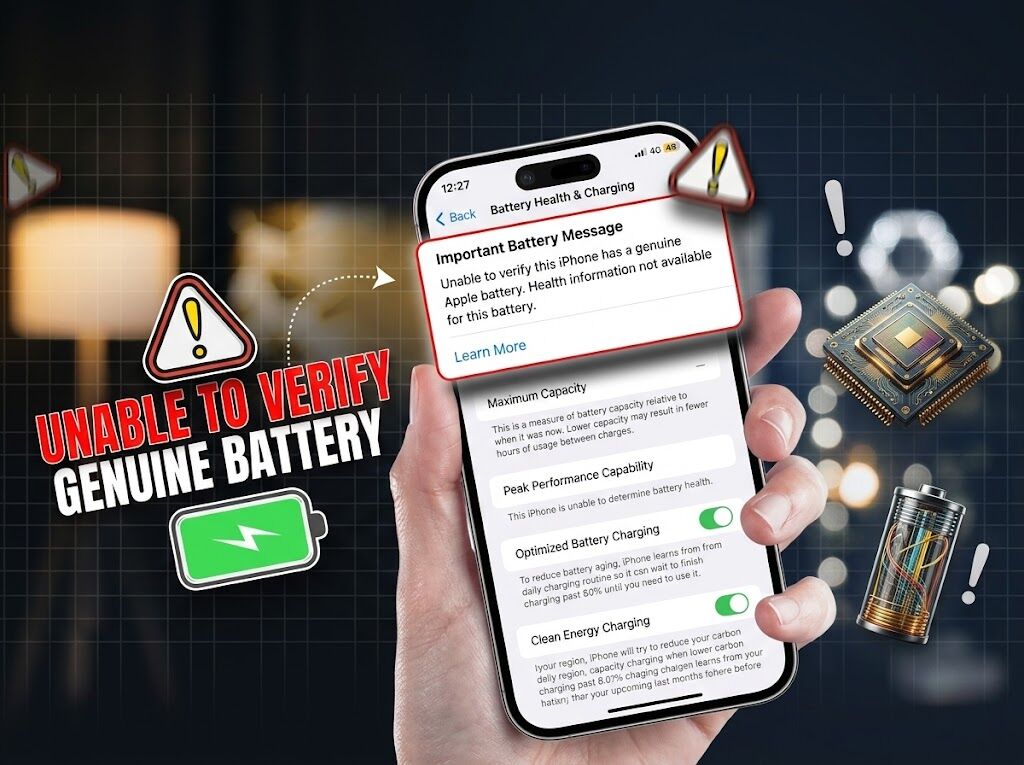
Not always. The right question is not ?can this battery be replaced?? but ?will a replacement increase my net return after cost and hassle?? For everyday, older models, the answer is often no. For cleaner premium models, especially where you are aiming for a higher grade, a replacement can make sense. The big caveot will be if that the repair service uses low quality batteries -In this insatnce the device will have the following message in settings "Unable to Verify" Apple battery - So ask first as this message on the device will lower the resale value
A sensible test:
Get a live sale quote as-is.
Estimate the real replacement cost, including time and inconvenience and potential risk
Only repair if the likely uplift is clearly more than the repair cost and the repair will not introduce extra risk.
Cheap third-party fixes can also create new problems. If the repair reduces buyer confidence, you may not recover the spend.
https://images.unsplash.com/photo-1510557880182-3d4d3cba35a5?auto=format&fit=crop&w=1600&q=80
For private sellers, the strongest approach is straightforward disclosure. If the battery is good, say so. If it is borderline, do not try to bury it. Buyers who feel misled are exactly the ones who create delays, disputes and requotes.
Before selling:
Open Settings > Battery > Battery Health & Charging.
Note the maximum capacity percentage.
Take a screenshot if you are selling privately or want your own record.
Use that figure when comparing offers.
Clear disclosure tends to speed up the whole process because the buyer does not have to ?discover? the issue for themselves later.
Battery health matters because it changes the commercial route for the buyer. A phone at 90% or above is easier to resell as a stronger cosmetic grade if the rest of the device is clean. Once battery health drops into the mid-80s, many buyers become more cautious because they may need to account for future complaints, reduced buyer confidence, or a replacement decision later in the chain.
On SellMyiPhone?s own terms, batteries below 85% trigger a requote and Grade A requires at least 90%. That means battery health is not just a technical metric; it directly affects how the phone is valued and how easily it can stay in the grade you selected. If the handset also shows a battery service warning, disclose it clearly rather than hoping it will be overlooked.
Check battery health before you request final quotes.
Declare any battery service warning in plain language.
Do not assume a clean shell offsets a weak battery.
Does battery health really affect price?
Yes. It often changes both the offer and whether the device is treated as straightforward stock or as a near-term repair.
Is 84% battery health bad?
It is not unusable, but it is typically in the zone where buyers start discounting for likely replacement.
Should I hide a weak battery and hope for the best?
No. Honest disclosure usually saves time and avoids requotes or disputes.
https://www.sellmyiphone.co.uk/faqs
People often use ?factory reset? and ?data erasure? as if they mean the same thing. They do not. For an ordinary private seller, a factory reset may be the sensible practical step. For a business-grade processing workflow, secure erasure is a different standard altogether because it is about evidence as well as deletion.
This guide focuses on the checks and decisions that most often affect value, payout speed and sale certainty for UK iPhone sellers.
A factory reset removes your content from normal view and returns the device to its standard setup flow. For most private sellers, that is the key personal step before handing the phone on. It protects your photos, messages and apps far better than doing nothing.
However, a factory reset is still a user-level action. It is not the same as a formally recorded data-erasure process with an audit trail.
The distinction is straightforward: where legal or corporate assurance is needed, proper erasure is about using an approved process that records the overwrite and produces evidence. That is why trade buyers and corporate processors talk about certification, not just about ?resetting the phone?.
In plain English, the difference is:
Factory reset: practical seller step to remove your personal content before sale
Secure erasure: controlled processing step carried out by the buying or refurbishing operation, with evidence that it happened
If you are selling your own handset, your priority is usually straightforward:
Back up what you need.
Sign out of iCloud and turn off Find My.
Erase all content and settings.
Remove SIM and accessories.
SellMyiPhone?s prep guidance says exactly that sequence matters, and it also states that the device will be erased again using MobiCode services once received. That gives you a sensible two-layer process: clear your personal access before sending, then let the buyer run their own controlled workflow on receipt.
The most common mix-up is thinking that because the screen shows the welcome setup page, every security and account issue has been resolved. That is not always true. If iCloud remains linked, you can still have an Activation Lock problem. If you skipped the backup, you can still lose data. If you are a business disposing of devices, you may still need a documented erasure record.
The good rule is simple: use the right standard for the job. Private sale? Factory reset plus account removal. Corporate disposal or compliance-heavy processing? Formal erasure workflow with proof.
For most personal sellers, the key point is that a factory reset prepares the phone for sale but should not be treated as a casual afterthought. You still need to back up first, remove account locks, and erase the device correctly so the next stage is clean. SellMyiPhone also states that it will erase remaining data on receipt, but the seller remains responsible for removing what they reasonably can before dispatch.
If the handset contains business data, regulated customer information, or anything sensitive, the standard rises. In that case you should think in terms of traceability and evidence, not only convenience. That is where secure erasure processes and documented handling become more important than a simple consumer reset.
Back up first, then sign out, then erase.
Do not send a device still linked to live accounts.
For work devices, keep a clearer audit trail than you would for a casual personal sale.
Is a factory reset enough before selling my own iPhone?
For most personal sellers, it is the essential practical step, but it should be paired with iCloud removal.
Is factory reset the same as secure data erasure?
No. Secure erasure is a documented, auditable process, not just a settings action.
Why do buyers re-erase devices?
Because professional processing usually applies its own controlled workflow and record-keeping on receipt.
https://www.sellmyiphone.co.uk/preparing-your-mobile-phone-for-sale
https://www.sellmyiphone.co.uk/pages/terms-and-conditions
https://ico.org.uk/for-organisations/uk-gdpr-guidance-and-resources/
https://support.apple.com/en-gb/guide/iphone/iph7a2a9399b/ios
Many sellers compare buy-back offers the wrong way. They look at the biggest headline number, assume that is the best deal, and ignore how the buyer handles grading, batteries, re-quotes, postage, speed and disputes. In the real world, the best offer is the one you are most likely to receive in your bank account.
Practical guidance: this guide focuses on the checks and decisions that most often affect value, payout speed and sale certainty for UK iPhone sellers.
Comparison sites and headline quotes can look generous, but some businesses initially show more than they ultimately pay. That does not mean every high quote is fake. It means the seller needs to understand what assumptions sit behind the number.
If a quote assumes ?excellent condition, strong battery, correct model, quick posting?, then a phone that arrives late or below expectation may be re-priced. A lower but more realistic quote can be the better commercial choice.
Use the same device facts every time. That means the same model, the same storage, the same battery range and the same honest condition. Then compare these variables:
Once you compare those points, the ?highest? offer is often no longer the most attractive.
The best quote is not the highest number on screen; it is the offer most likely to convert into real money without friction.
A useful sense-check is to compare a buy-back offer against what that same sort of device is being sold for on the buyer?s own channels or in the wider market. A business needs headroom for testing, handling, risk and resale margin. If a quote looks too close to retail, treat it carefully and read the grading assumptions twice.
This is not about cynicism. It is about understanding how the economics of used phones actually work.
SellMyiPhone gives some useful benchmarks you can compare against. On the site, quoted prices are held for 14 days, so speed matters. If a device arrives later, it may be re-quoted at the current market rate. The FAQ states that payment is aimed on the same day for items processed by 3pm on weekdays, provided the device matches the description.
That means a good comparison is not ?Who shows the biggest number??. It is ?Who is clearest about the process, the conditions and the likely final payout??. The more transparent the rules, the easier it is to judge whether the quote is real-world usable.
A strong comparison is based on net certainty, not the biggest number on the first screen. Two offers can look similar but produce very different real outcomes once you account for grading strictness, battery rules, speed of payment, return handling after a requote, and how much evidence the buyer expects if there is a dispute. That is where weak comparisons go wrong.
The disciplined way to compare offers is to submit the same model, same storage, same battery facts, and same condition description to each buyer on the same day. Then compare not only the quoted figure, but also the practical risk of that figure holding once the device is inspected. A slightly lower quote from a buyer with clearer rules can be the better commercial result.
Should I always choose the highest quote?
No. The best quote is the one most likely to survive grading, battery checks and processing.
What is the biggest hidden issue?
Condition and battery assumptions are the most common reasons headline quotes change later.
How do I compare fairly?
Use the same honest device details for every quote and compare the rules, not just the number.
Posting an iPhone safely is not just about putting it in a padded envelope and hoping for the best. A smooth sale depends on account removal, sensible packaging, the right postal service for the value, and good evidence in case anything is disputed or damaged in transit.
Practical guidance: this guide focuses on the checks and decisions that most often affect value, payout speed and sale certainty for UK iPhone sellers.
Most posting problems are not dramatic courier failures. They are ordinary seller mistakes: sending the phone while still iCloud-linked, using weak packaging, dropping a high-value device into the wrong service, or posting without any condition evidence.
That is why shipping should be treated as part of the sale process, not as the forgettable last step.
The preparation guide recommends photographing the device before posting and noting the IMEI before it leaves your hands.
Good shipping is about removing avoidable risk: account locks, poor packaging, under-insured postage and missing proof.
The SellMyiPhone preparation page provides a useful real-world benchmark. It says the supplied post-back label covers devices up to £100, and it recommends Royal Mail Special Delivery for higher-value items. That matters because plenty of recent iPhones are worth far more than the low-value threshold a standard posting method may cover.
The preparation guide says the standard included label covers devices up to £100 and recommends Royal Mail Special Delivery for higher-value items.
In short: match the shipping method to the value of the handset, not to your optimism.
If a parcel is delayed, damaged or questioned, your evidence is what protects you. The most useful evidence is simple:
This is not paranoia. It is basic hygiene for sending an item that may be worth hundreds of pounds.
Safe shipping is not only about avoiding physical damage. It is about making the parcel, the declared condition, and the paperwork line up so that if anything goes wrong you have a clean record. The strongest evidence stack is simple: clear pre-send photos, IMEI noted privately, proof of postage, tracking, and packaging that matches the device value.
SellMyiPhone?s guide is practical here: its standard label covers devices up to £100, but for higher-value handsets it strongly recommends upgrading to Royal Mail Special Delivery. That matters because too many sellers use the basic included label for premium devices and only think about cover once something is delayed or damaged.
Can I just put my iPhone in a post box?
No. If the item has value, it should go through a proper counter service with proof and appropriate cover.
What is the biggest shipping mistake?
Sending a valuable phone with poor packaging or inadequate delivery cover.
Should I photograph the phone before posting?
Yes. It is one of the simplest ways to protect yourself if condition is later disputed.
Grading is one of the biggest sources of confusion in used-phone sales. Sellers say ?good condition? when they mean ?works fine but has marks?. Buyers hear ?good condition? and imagine something far cleaner. That gap is where requotes, returns and arguments begin.
Practical guidance: this guide focuses on the checks and decisions that most often affect value, payout speed and sale certainty for UK iPhone sellers.
The core problem is simple: returns often come from grading discrepancies because customers interpret condition labels differently. That is why vague, optimistic grading hurts both sides.
Grading is not there to flatter the device. It is there to create a common language for price.
Every business uses its own labels, but this plain-English framework helps:
If there is a real functional issue, do not try to squeeze the phone into a cosmetic grade. Call the fault what it is.
Good grading is not fancy jargon; it is the practical language that stops buyers and sellers talking past each other.
In day-to-day trade, grading by eye is still one of the fastest and most practical methods. Automated grading tools may improve over time, but for now, clear human judgement is often more useful than overcomplicated scoring if the team is disciplined.
The important part is consistency. Two people should reach broadly the same conclusion when they look at the same handset.
Overgrading may get you a nicer headline quote, but it usually just stores up a re-quote later. Accurate grading gets the sale done faster.
Good grading is less about memorising labels and more about understanding what pushes a device into a different resale route. A phone can look tidy at first glance and still miss a stronger grade because of battery thresholds, service warnings, non-genuine part alerts, or scratches that become obvious once the screen is off under bright light. SellMyiPhone explicitly states that devices are assessed with the screen both on and off for exactly this reason.
For sellers, the safest habit is to grade slightly conservatively. If you are between two grades, choose the lower one and protect the chance of a smooth payout. Over-grading often creates disappointment, delay, and a revised offer; cautious grading usually preserves trust and keeps the transaction moving.
What is the biggest grading mistake?
Calling a clearly used handset ?excellent? because it still works.
Is manual grading good enough?
Yes, if it is honest and consistent. Clear human grading is still the practical standard in many real workflows.
Should battery issues be part of grading?
They should be disclosed separately, because a battery issue is not just a cosmetic point.
Getting the model and storage right sounds obvious, but it is one of the most common seller errors. The difference between 128GB and 256GB, or between a Pro and a Pro Max, can materially change the quote. If you guess, you are effectively asking to be re-priced later.
Practical guidance: this guide focuses on the checks and decisions that most often affect value, payout speed and sale certainty for UK iPhone sellers.
Used-phone pricing is built on exact specification. A buyer is not paying for ?an iPhone 13-ish?. They are paying for a specific model, capacity, colour and condition profile. If you choose the wrong variant, the quoted price may look great ? right up until the phone is inspected.
The simplest way to protect yourself is to confirm the details from the handset, not from memory.
On the phone, go to Settings > General > About. That gives you the model name, storage and serial details in one place. You can also compare the model number against Apple?s published identifiers if you need extra certainty.
If the phone no longer powers on, check the original purchase record, box label if you still have it, or any account record that shows the exact device.
The wrong model or storage selection is one of the easiest ways to turn a smooth sale into a needless re-quote.
Many people accidentally describe the storage they wish they bought, or the storage they happen to have free, rather than the storage the handset actually has. A phone with 20GB free space is not automatically a 64GB phone. Likewise, having ?loads of photos? does not make it a 256GB model.
Always use the reported specification, not an estimate based on usage.
Before taking any quote, write down or screenshot the exact model and capacity. Then use that same reference each time you compare offers. That one-minute habit removes an enormous amount of avoidable friction.
The boring details are what make the payout predictable.
Small identification errors create surprisingly large admin problems. Getting the storage wrong, confusing one model generation with another, or quoting the wrong network or colour can make a buyer question the whole submission. Even when the error is honest, it slows the process because the quote has to be revisited and the transaction becomes less straightforward than it should have been.
That is why the best approach is to verify the handset from the phone itself before you quote. Check the model name, storage, IMEI, and any obvious warnings in settings, then compare that to what you enter online. A careful two-minute check at the start saves much more time than an apologetic correction later.
Where do I check model and storage?
Settings > General > About is the simplest place on a working iPhone.
Can the wrong storage choice affect price much?
Yes. Storage differences can materially change the quoted value.
Should I just pick the closest option?
No. If you are unsure, confirm the exact specification first.
If you are not ready to sell today but know you will sell soon, a simple weekly resale check keeps you in control. It helps you notice value drift, worsening battery condition, upcoming launches and the moment when ?I?ll do it later? starts costing you money.
Practical guidance: this guide focuses on the checks and decisions that most often affect value, payout speed and sale certainty for UK iPhone sellers.
People rarely lose money because they forgot the phone existed. They lose money because they knew they meant to sell it, but kept postponing the final steps. A weekly check is a small discipline that keeps the sale alive rather than letting it fade into the background.
It is especially useful if you are waiting for an upgrade, a family handover, or the end of a contract.
This takes minutes, not hours.
A quick weekly check stops a good sale from turning into a forgotten task that quietly loses value.
If the quote is good enough, the battery is drifting, or you have already upgraded, the weekly check should stop being a monitoring routine and turn into action. The whole point is to notice when waiting has stopped helping.
A ?pretty good? price today is often better than a theoretically better price you never actually secure.
At the end of each weekly review, force yourself into one of three outcomes:
That tiny decision prevents endless passive delay. A routine only works if it leads somewhere.
A weekly value check should not be an obsessive refresh of prices. It should be a disciplined snapshot of the facts that actually move your likely payout: current quote level, battery health, any new cosmetic wear, whether the phone is still fully unlocked and ready to send, and whether your decision to sell is drifting into delay. If those facts worsen while you keep waiting, your real position is probably weakening.
The goal of a weekly check is to stop indecision becoming a hidden loss. If the quote is acceptable and the phone is ready, the best next step is usually to convert monitoring into action. Tracking value is useful only if it helps you make a better decision, not if it becomes an excuse to postpone one.
How often should I check resale value?
Weekly is usually enough if you are actively planning to sell soon.
What is the biggest sign I should stop waiting?
A decent quote combined with falling battery, rising wear or the fact you already no longer use the phone.
Is constant checking useful?
Not really. A calm weekly review is normally enough to stay on top of the market.